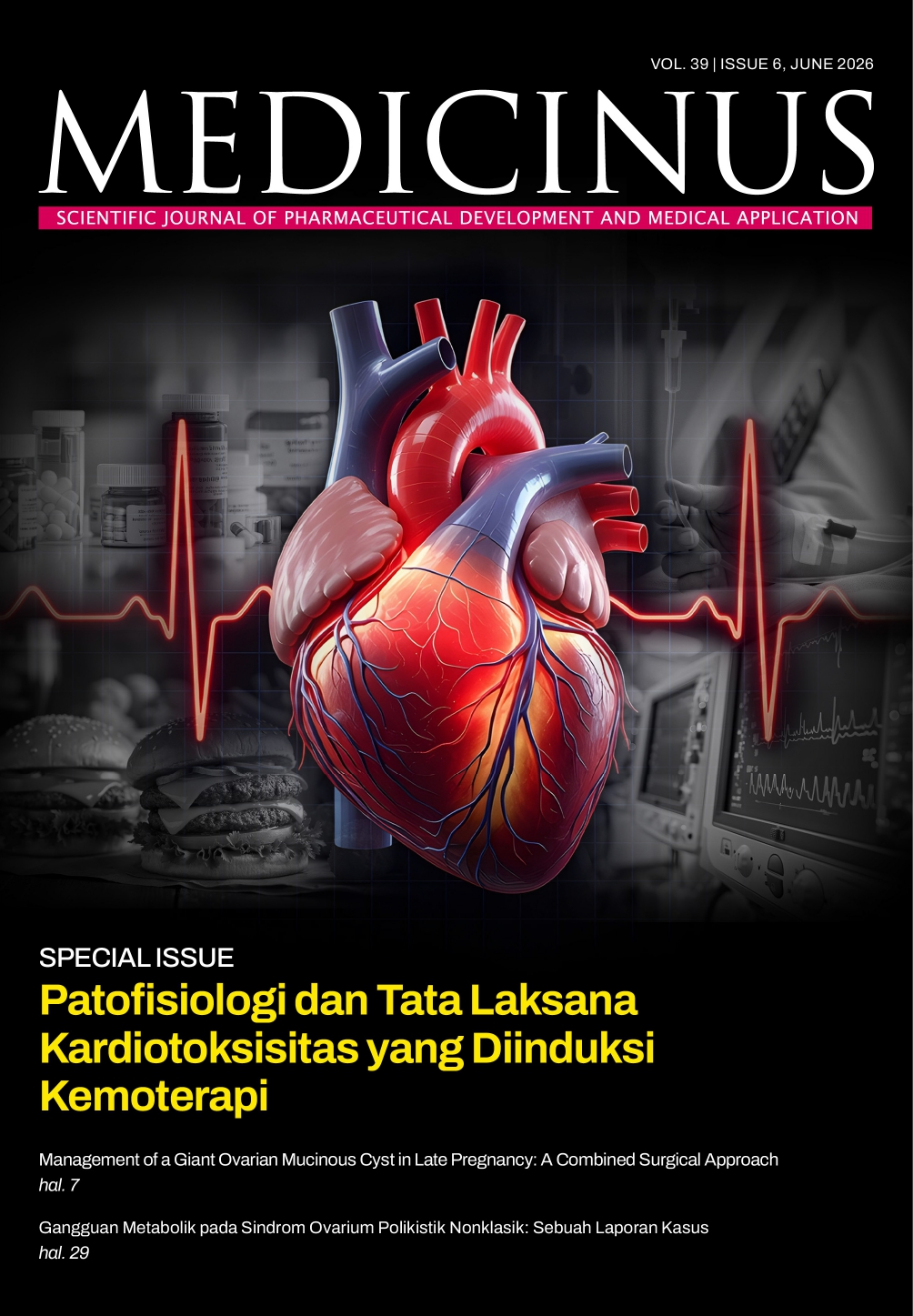
Patofisiologi dan Tata Laksana Kardiotoksisitas yang Diinduksi Kemoterapi
DOI:
https://doi.org/10.56951/3hzabj15Kata Kunci:
kardiotoksisitas, kanker, kemoterapiAbstrak
Menurut European Society of Cardiology (ESC), kardiotoksisitas didefinisikan sebagai kerusakan fungsi maupun struktur organ jantung yang berhubungan dengan paparan obat, terutama terapi antikanker seperti kemoterapi dan radioterapi, maupun akibat dari kanker itu sendiri. Secara umum, kardiotoksisitas yang diinduksi kemoterapi diklasifikasikan ke dalam lima jenis, dengan dua tipe utama yang paling sering dikaitkan dengan terapi antineoplastik berisiko tinggi. Mekanisme kardiotoksisitas yang diinduksi kemoterapi dapat terjadi baik secara langsung maupun tidak langsung, dengan faktor
yang berperan antara lain: dosis kumulatif, sediaan obat, formulasi, serta metode penghantaran obat. Penatalaksanaan kardiotoksisitas bergantung pada jenis gangguan kardiovaskular yang dialami oleh pasien. Pada kondisi hipertensi, angiotensin-converting enzyme inhibitors (ACEI), angiotensin receptor blockers (ARB), atau calcium channel blockers golongan dihydropyridine merupakan pilihan terapi yang direkomendasikan. Terapi antikanker masih dapat dilanjutkan selama interval QT ≤500 ms dan perubahan interval QT <60 ms, serta tidak ditemukan aritmia ventrikel maupun
sinkop. Untuk penanganan fibrilasi atrium, didasarkan pada pertimbangan utama, yaitu kontrol irama dan kontrol laju, serta profilaksis tromboemboli. Pencegahan kardiotoksisitas dimulai dengan penilaian risiko kardiovaskular dan faktor predisposisi secara komprehensif. Pasien dengan banyak faktor risiko, terutama bila kondisi tidak terkontrol dengan baik, dan/atau memiliki penyakit kardiovaskular yang telah ada sebelumnya, memerlukan tata laksana yang sama dengan pasien yang berisiko tinggi.
Unduhan
Referensi
1. Armenian SH, Lacchetti C, Barac A, Carver J, Constine LS, Denduluri N, et al. Prevention and monitoring of cardiac dysfunction in survivors of adult cancers: American Society of Clinical Oncology clinical practice guideline. J Clin Oncol. 2017;35:893–911. doi:10.1200/JCO.2016.70.5400.
2. Huang W, Xu R, Zhou B, Lin C, Guo Y, Xu H, et al. Clinical manifestations, monitoring, and prognosis: a review of cardiotoxicity after antitumor strategy. Front Cardiovasc Med. 2022;9:912329. doi:10.3389/fcvm.2022.912329.
3. Lyon AR, Yousaf N, Battisti NML, Moslehi J, Larkin J. Immune checkpoint inhibitors and cardiovascular toxicity. Lancet Oncol. 2018;19:e447–58. doi:10.1016/S1470-2045(18)30457-1.
4. Curigliano G, Cardinale D, Dent S, Criscitiello C, Aseyev O, Lenihan D, et al. Cardiotoxicity of anticancer treatments: epidemiology, detection, and management. CA Cancer J Clin. 2016;66(4):309–25. doi:10.3322/caac.21341.
5. Touyz RM, Herrmann J. Cardiotoxicity with vascular endothelial growth factor inhibitor therapy. NPJ Precis Oncol. 2018;2:13. doi:10.1038/s41698-018-0056-z.
6. Koutsoukis A, Ntalianis A, Repasos E, Kastritis E, Dimopoulos MA, Paraskevaidis I. Cardio-oncology: a focus on cardiotoxicity. Eur Cardiol. 2018;13(1):64–9. doi:10.15420/ecr.2017:17:2.
7. Kalogeropoulos AP, Fonarow GC, Georgiopoulou V, Burkman G, Siwamogsatham S, Patel A, et al. Characteristics and outcomes of adult outpatients with heart failure and improved or recovered ejection fraction. JAMA Cardiol. 2016;1(5):510–8. doi:10.1001/jamacardio.2016.1325.
8. Fernández AE. Chemotherapy-induced dysfunction. E-Journal of Cardiology Practice. 2017;14. Available from: https://www.escardio.org/communities/councils/cardiology-practice/scientific-documents-andpublications/ejournal/volume-14/Chemotherapy-induced-dysfunction/.
9. Chung R, Ghosh AK, Banerjee A. Cardiotoxicity: precision medicine with imprecise definitions. Open Heart. 2018;5(2):e000774. doi:10.1136/openhrt-2018-000774.
10. Gabani M, Castañeda D, Nguyen QM, Choi SK, Chen C, Mapara A, et al. Association of cardiotoxicity with doxorubicin and trastuzumab: a double-edged sword in chemotherapy. Cureus. 2021;13(9):e18194. doi:10.7759/cureus.18194.
11. Perez IE, Taveras Alam S, Hernandez GA, Sancassani R. Cancer therapy-related cardiac dysfunction: an overview for the clinician. Clin Med Insights Cardiol. 2019;13:1179546819866445. doi:10.1177/1179546819866445.
12. Zamorano JL, Lancellotti P, Rodriguez Muñoz D, Aboyans V, Asteggiano R, Galderisi M, et al. 2016 ESC position paper on cancer treatments and cardiovascular toxicity. Eur Heart J. 2016;37(36):2768–801. doi:10.1093/eurheartj/ehw211.
13. Zhang S, Liu X, Bawa-Khalfe T, Lu LS, Lyu YL, Liu LF, et al. Identification of the molecular basis of doxorubicin-induced cardiotoxicity. Nat Med. 2012;18(11):1639–42. doi:10.1038/nm.2919.
14. Narezkina A, Narayan HK, Zemljic-Harpf AE. Molecular mechanisms of anthracycline cardiovascular toxicity. Clin Sci (Lond). 2021;135(10):1311–32. doi:10.1042/CS20200301.
15. Hahn VS, Lenihan DJ, Ky B.. Cancer therapy–induced cardiotoxicity: basic mechanisms and potential cardioprotective therapies. J Am Heart Assoc. 2014;3(2):e000665. doi:10.1161/JAHA.113.00066ss.
16. Rawat PS, Jaiswal A, Khurana A, Bhatti JS, Navik U. Doxorubicin-induced cardiotoxicity: an update on the molecular mechanism and novel therapeutic strategies for effective management. Biomed Pharmacother. 2021;139:111708. doi:10.1016/j.biopha.2021.111708.
17. Tocchetti CG, Cadeddu C, Di Lisi D, Femminò S, Madonna R, Mele D, et al. From molecular mechanisms to clinical management of antineoplastic drug-induced cardiovascular toxicity: a translational overview. Antioxid Redox Signal. 2019;30(18):2110–53. doi:10.1089/ars.2016.6930.
18. Lin M, Xiong W, Wang S, Li Y, Hou C, Li C, et al. The research progress of trastuzumab-induced cardiotoxicity in HER2-positive breast cancer treatment. Front Cardiovasc Med. 2022;8:821663. doi:10.3389/fcvm.2021.821663.
19. Dhesi S, Chu MP, Blevins G, Paterson I, Larratt L, Oudit GY, et al. Cyclophosphamide-induced cardiomyopathy: a case report, review, and recommendations for management. J Investig Med High Impact Case Rep. 2013;1(1):2324709613480346. doi:10.1177/2324709613480346.
20. Alexandre J, Cautela J, Ederhy S, Damaj GL, Salem JE, Barlesi F, et al. Cardiovascular toxicity related to cancer treatment: a pragmatic approach to the American and European cardio-oncology guidelines. J Am Heart Assoc. 2020;9(18):1–14. doi:10.1161/120.018403.
21. Curigliano G, Lenihan D, Fradley M, Ganatra S, Barac A, Blaes A, et al. Management of cardiac disease in cancer patients throughout oncological treatment: ESMO consensus recommendations. Ann Oncol. 2020;31:171–90. doi:10.1016/j.annonc.2019.10.023.
22. Baumert M, Porta A, Vos MA, Malik M, Couderc JP, Laguna P, et al. QT interval variability in body surface ECG: measurement, physiological basis, and clinical value: position statement and consensus guidance endorsed by the European Heart Rhythm Association jointly with the ESC Working Group on Cardiac Cellular Electrophysiology. Europace. 2016;18(6):925–44. doi:10.1093/europace/euv405.
23. Baumert M, Porta A, Vos MA, Malik M, Couderc JP, Laguna P, et al. QT interval variability in body surface ECG: measurement, physiological basis, and clinical value. Europace. 2016;18(6):925–44. doi:10.1093/europace/euv405.
24. Cardinale D, Colombo A, Sandri MT, Lamantia G, Colombo N, Civelli M, et al. Prevention of high-dose chemotherapy-induced cardiotoxicity in high-risk patients by angiotensin-converting enzyme inhibition. Circulation. 2006;114(23):2474–81. doi:10.1161/CIRCULATIONAHA.106.635144.
25. Griguolo G, Guarneri V. Cardiac complications of cancer and anticancer treatment. In: Vermorken JB, Roila F, editors. ESMO Handbook of Oncological Emergencies. 2nd ed. Lugano: European Society for Medical Oncology; 2016. p.3–16.
Unduhan
Terbitan
Bagian
Diterbitkan
Unduhan
Lisensi
Hak Cipta (c) 2026 Helen Widiani, Ida Bagus Rangga Wibhuti

Artikel ini berlisensi Creative Commons Attribution-NonCommercial 4.0 International License.
Cara Mengutip