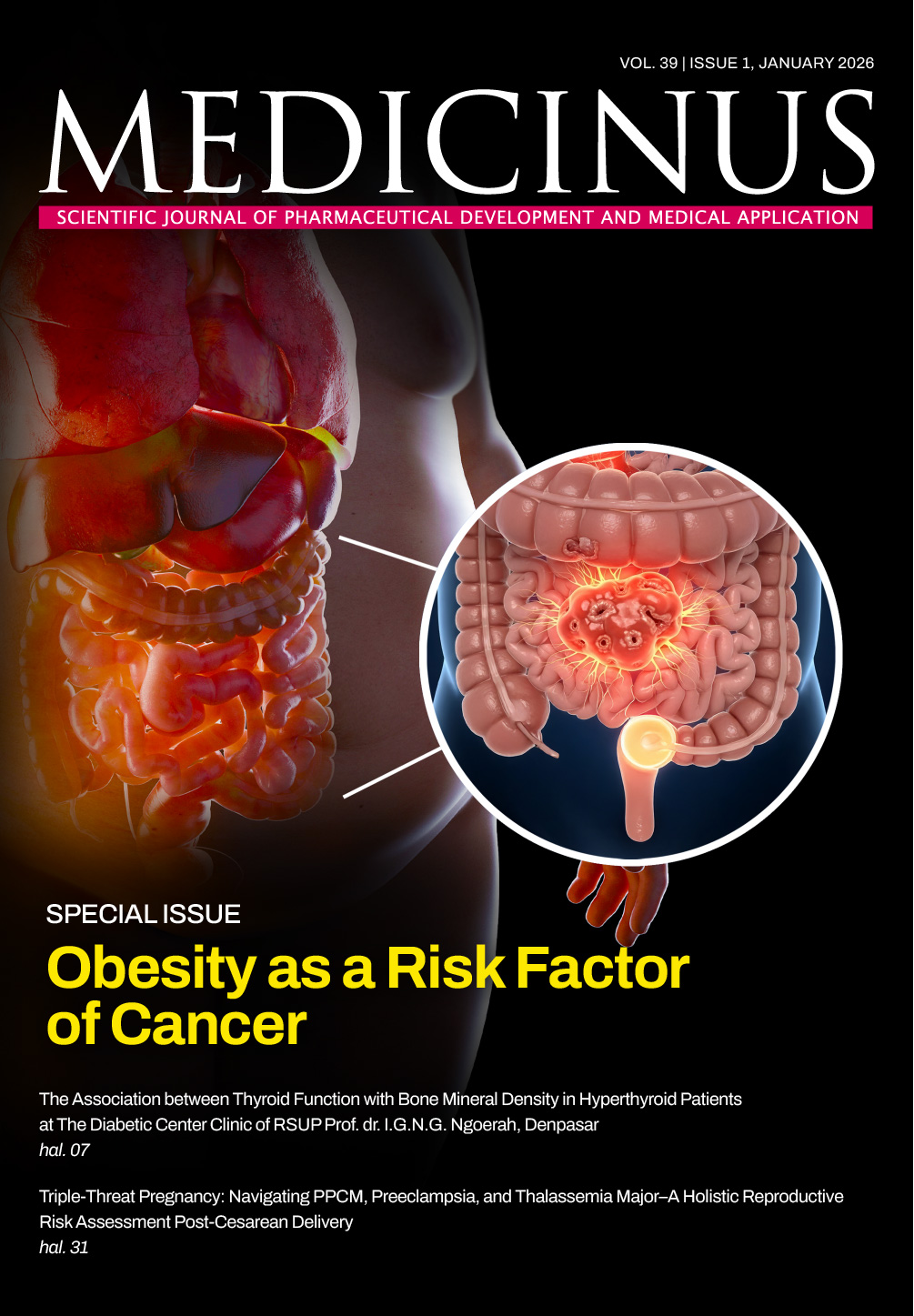
Obesity as a Risk Factor of Cancer
DOI:
https://doi.org/10.56951/xjymmp28Kata Kunci:
obesitas, overweight, kanker, tumorigenesis, inflamasi kronisAbstrak
Prevalensi kelebihan berat badan (overweight) dan obesitas terus meningkat secara global. Kondisi ini dianggap sebagai masalah kesehatan masyarakat yang serius karena korelasinya dengan penyakit lain seperti diabetes melitus tipe 2, penyakit kardiovaskular, dan kanker. Obesitas didefinisikan sebagai penumpukan lemak tubuh abnormal atau berlebihan yang dapat mengganggu kesehatan. Meskipun obesitas tidak dianggap sebagai faktor risiko utama penyakit kanker, obesitas terkait dengan beberapa jenis kanker. Salah satu mekanisme utama yang mendasari hubungan antara obesitas dan kanker adalah inflamasi kronis. Pada individu dengan obesitas, hipoksia dapat terjadi pada jaringan adiposa, yang memicu perubahan kadar leptin, disregulasi adiponektin, infiltrasi makrofag, disfungsi mitokondria, dan peningkatan respons stres retikulum endoplasma. Perubahan-perubahan tersebut secara kolektif berkontribusi pada kondisi inflamasi kronis. Inflamasi kronis memperantarai perkembangan sel kanker, terutama dengan menginduksi perubahan pada lingkungan mikro tumor dan mendorong pembentukan fenotipe kanker (tumorigenesis). Faktor-faktor lain yang menjelaskan hubungan antara obesitas dan kanker secara umum akan dijelaskan dalam tinjauan literatur ini.
Unduhan
Referensi
1. World Health Organization. Obesity and overweight [Internet]. 2020 [cited 2025, Nov 1]. Available from: https://www.who.int/news-room/fact-sheets/detail/obesity-and-overweight.
2. Barata Cavalcanti O, Barquera S, Baur L, Busch V, Buse K, Dietz B, et al. World Obesity Atlas. London: World Obesity Federation; 2022.
3. Fitzmaurice C, Akinyemiju T, Abera S, Ahmed M, Alam N, Alemayohu MA, et al. The burden of primary liver cancer and underlying etiologies from 1990 to 2015: results from the Global Burden of Disease Study 2015. JAMA Oncol. 2017;3(12):1683–91.
4. Kementerian Kesehatan Republik Indonesia. Laporan Riskesdas Nasional 2018. Jakarta: Badan Penelitian dan Pengembangan Kesehatan; 2018.
5. Ghanemi A, Yoshioka M, St-Amand J. Ageing and obesity shared patterns: from molecular pathogenesis to epigenetics. Diseases. 2021;9(4):87.
6. International Agency for Research on Cancer. The Global Cancer Observatory – All cancers. Int Agency Res Cancer – WHO. 2020;419:199–200.
7. Xu YXZ, Mishra S. Obesity-linked cancers: current knowledge, challenges and limitations in mechanistic studies and rodent models. Cancers (Basel). 2018;10(12):1–20.
8. Nedeltcheva AV, Scheer FAJL. Metabolic effects of sleep disruption, links to obesity and diabetes. Curr Opin Endocrinol Diabetes Obes. 2014;21(4):293–8.
9. Setiawan VW, Yang HP, Pike MC, McCann SE, Yu H, Xiang YB, et al. Type I and II endometrial cancers: have they different risk factors? J Clin Oncol. 2013;31(20):2607–18.
10. Colditz GA, Lindsay L. Obesity and cancer: Evidence, impact, and future directions. Clin Chem. 2018;64(1):154–62.
11. Meyers EC, Solorzano BR, James J, Ganzer PD, Elaine S, Rennaker RL, et al. Early life body fatness and risk of colorectal cancer in US women and men: results from two large cohort studies. Physiol Behav. 2018;176:100–6.
12. Heyn GS, Corrêa LH, Magalhães KG. The impact of adipose tissue–derived miRNAs in metabolic syndrome, obesity, and cancer. Front Endocrinol (Lausanne). 2020;11:1–15.
13. Lega IC, Lipscombe LL. Diabetes, obesity, and cancer: pathophysiology and clinical implications. Endocr Rev. 2020;41(1):33–52.
14. Avgerinos KI, Spyrou N, Mantzoros CS, Dalamaga M. Obesity and cancer risk: emerging biological mechanisms and perspectives [Internet]. Metabolism. 2019;92:121–35.
15. Iacobini C, Pugliese G, Blasetti Fantauzzi C, Federici M, Menini S. Metabolically healthy versus metabolically unhealthy obesity. Metabolism. 2019;92:51–60.
16. Blüher M. Metabolically healthy obesity. Endocr Rev. 2020;41(3):405–20.
17. Lavie CJ, Laddu D, Arena R, Ortega FB, Alpert MA, Kushner RF. Healthy weight and obesity prevention: JACC Health Promotion Series. J Am Coll Cardiol. 2018;72(13):1506–31.
18. Caleyachetty R, Thomas GN, Toulis KA, Mohammed N, Gokhale KM, Balachandran K, et al. Metabolically healthy obese and incident cardiovascular disease events among 3.5 million men and women. J Am Coll Cardiol. 2017;70(12):1429–37.
19. Durward CM, Hartman TJ, Nickols-Richardson SM. All-cause mortality risk of metabolically healthy obese individuals in NHANES III. J Obes. 2012;2012:1–9.
20. Ng Marie, Fleming T, Robinson M, Thomson B, Graetz N, Margono C, et al. Global, regional and national prevalence of overweight and obesity in children and adults 1980–2013: a systematic analysis. Lancet. 2014;384(9945):766–81.
21. World Health Organization. The Asia-Pacific perspective: Redefining obesity and its treatment. Geneva: WHO; 2000.
22. Centers for Disease Control and Prevention. Leading causes of death [Internet]. 2023 [cited 2025, Nov 1]. Available from: https://www.cdc.gov/nchs/fastats/leading-causes-of-death.htm.
23. Kocarnik JM, Compton K, Dean FE, Fu W, Gaw BL, Harvey JD, et al. Cancer incidence, mortality, years of life lost, years lived with disability, and disability-adjusted life years for 29 cancer groups from 2010 to 2019: a systematic analysis for the Global Burden of Disease Study 2019. JAMA Oncol. 2022;8(3):420–44.
24. Steele CB, Thomas CC, Henley SJ, Massetti GM, Galuska DA, Agurs-Collins T, et al. Vital signs: trends in incidence of cancers associated with overweight and obesity—United States, 2005–2014. MMWR Morb Mortal Wkly Rep. 2017;66(39):1052–8.
25. Lan N, Lu Y, Zhang Y, Pu S, Xi H, Nie X, et al. FTO – A common genetic basis for obesity and cancer. Front Genet. 2020;11:1–12.
26. Du X, Hidayat K, Shi BM. Abdominal obesity and gastroesophageal cancer risk: systematic review and meta-analysis of prospective studies. Biosci Rep. 2017;37(3):BSR20170945.
27. Renehan AG, Zwahlen M, Egger M. Adiposity and cancer risk: new mechanistic insights from epidemiology. Nat Rev Cancer. 2015;15(8):484–98.
28. Van den Brandt PA, Calle EE, Rodriguez C, et al. Anthropometry and pancreatic cancer risk: a pooled analysis of cohort studies. Int J Cancer. 2012;129(7):1708–17.
29. Somasundar P, Yu AK, Vona-Davis L, McFadden DW. Differential effects of leptin on cancer in vitro. J Surg Res. 2003;113(1):50–5.
30. Parida S, Siddharth S, Sharma D. Adiponectin, obesity, and cancer: clash of the bigwigs in health and disease. Int J Mol Sci. 2019;20(10):2519.
31. Stone TW, McPherson M, Darlington LG. Obesity and cancer: existing and new hypotheses for a causal connection. EBioMedicine. 2018;30:14–28.
32. Divella R, De Luca R, Abbate I, Naglieri E, Daniele A. Obesity and cancer: the role of adipose tissue and adipo-cytokines-induced chronic inflammation. J Cancer. 2016;7(15):2346–59.
33. Deng T, Lyon CJ, Bergin S, Caligiuri MA, Hsueh WA. Obesity, inflammation, and cancer. Annu Rev Pathol. 2016;11:421–49.
34. Dalamaga M, Diakopoulos KN, Mantzoros CS. The role of adiponectin in cancer: a review of current evidence. Endocr Rev. 2012;33(4):547–94.
35. Dikalov SI, Nazarewicz RR. Angiotensin II-induced production of mitochondrial reactive oxygen species: potential mechanisms and relevance for cardiovascular disease. Antioxid Redox Signal. 2013;19(10):1085–94.
36. Pollak M. The insulin and insulin-like growth factor receptor family in neoplasia: an update. Nat Rev Cancer. 2012;12(3):159–69.
37. Wu Q, Li B, Li J, Sun S, Yuan J, Sun S. Cancer-associated adipocytes: key players in breast cancer progression. J Hematol Oncol. 2021;14(1):95.
38. Nieman KM, Kenny HA, Penicka CV, Ladanyi A, Buell-Gutbrod R, Zillhardt MR, et al. Adipocytes promote ovarian cancer metastasis and provide energy for rapid tumor growth. Nat Med. 2011;17(11):1498–503.
39. Laurent V, Guérard A, Mazerolles C, Le Gonidec S, Toulet A, Nieto L, et al. Periprostatic adipocytes act as a driving force for prostate cancer progression in obesity. Nat Commun. 2016;7:10230.
40. Chen JL, Du B. From obesity to cancer: FTO, an m6A RNA demethylase, regulates tumour progression. J Cancer Res Clin Oncol. 2019;145(1):19–29.
41. Akbari ME, Gholamalizadeh M, Doaei S, Mirsafa F. FTO gene affects obesity and breast cancer through similar mechanisms: a new insight into the molecular therapeutic targets. Nutr Cancer. 2017;70(1):30–6.
42. Zhang Z, Zhou D, Lai Y, Liu Y, Tao X, Wang Q, et al. Estrogen induces endometrial cancer cell proliferation and invasion by regulating the fat mass and obesity-associated gene via PI3K/AKT and MAPK signaling pathways. Cancer Lett. 2012;319(1):89–97.
43. Xu D, Shao W, Jiang Y, Wang X, Liu Y, Liu X. FTO expression is associated with the occurrence of gastric cancer and prognosis. Oncol Rep. 2017;38(4):2285–92.
44. Nedooshan JJ, Kargar S, Neamatzadeh H, Haghighi F, Abadi RDM, Seddighi N. Lack of association of the fat mass and obesity-associated (FTO) gene rs9939609 polymorphism with breast cancer risk: a systematic review and meta-analysis. Asian Pac J Cancer Prev. 2017;18(4):1031–7.
45. Hotamisligil GS. Inflammation, metaflammation and immunometabolic disorders. Nature. 2017;542(7640):177–85.
46. Virtue A, Johnson C, Lopez-Pastraña J, Shao Y, Fu H, Li X, et al. MicroRNA-155 deficiency leads to decreased atherosclerosis, increased white adipose tissue obesity, and non-alcoholic fatty liver disease: a novel mouse model of the obesity paradox. J Biol Chem. 2017;292(4):1267–87.
Unduhan
Terbitan
Bagian
Diterbitkan
Unduhan
Lisensi
Hak Cipta (c) 2026 Theodore Dharma Tedjamartono, Ketut Suastika

Artikel ini berlisensi Creative Commons Attribution-NonCommercial 4.0 International License.
Cara Mengutip