Resistensi Insulin sebagai Poros Disfungsi Ovulasi pada Polycystic Ovary Syndrome
DOI:
https://doi.org/10.56951/wnqbb620Editorial
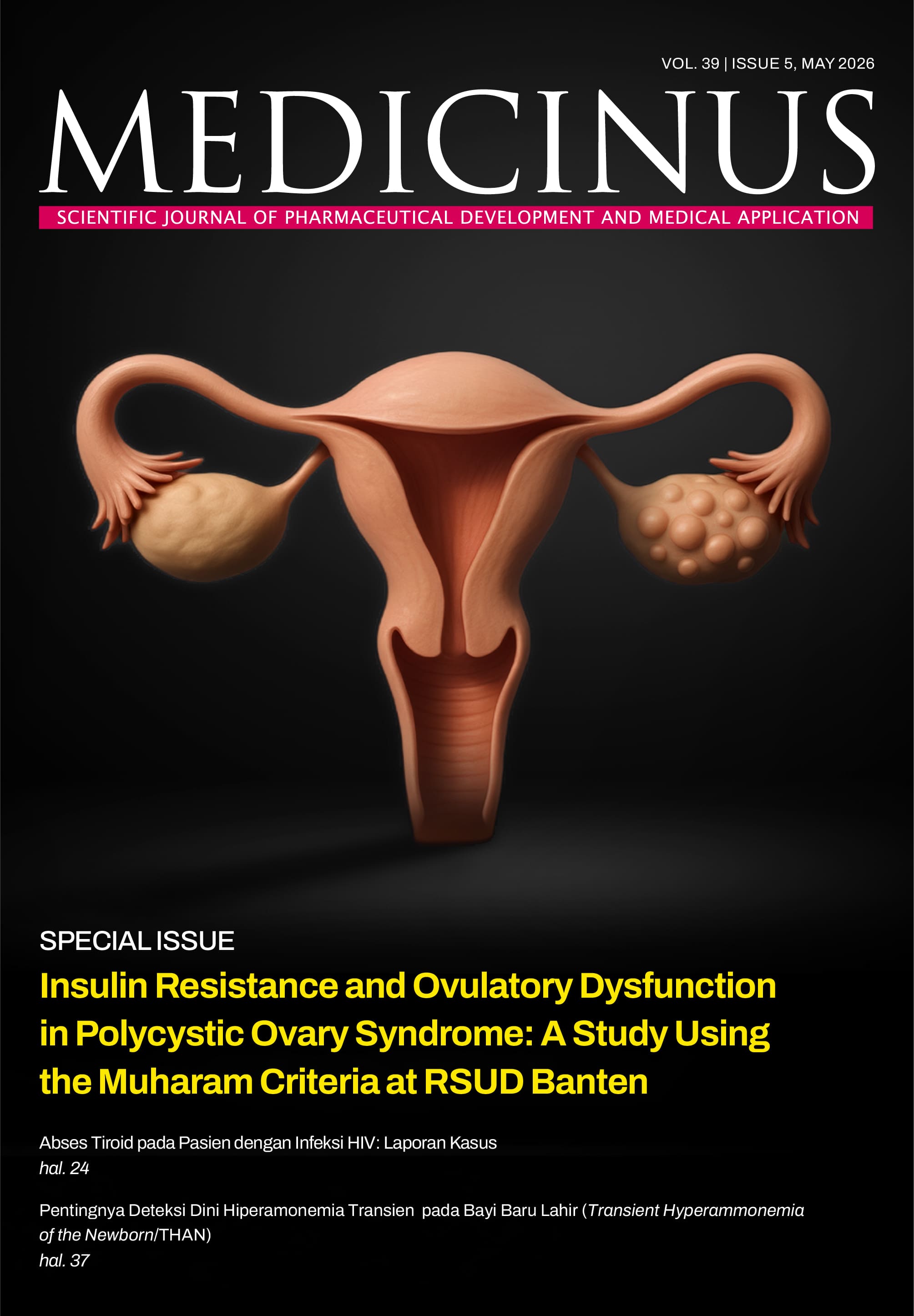
Resistansi insulin pada sindrom ovarium polikistik (polycystic ovary syndrome/PCOS) bersifat intrinsik dan bukan sekadar konsekuensi dari obesitas. Gangguan fosforilasi pascareseptor, khususnya peningkatan fosforilasi serine pada reseptor insulin dan substrat reseptor insulin, menghambat aktivasi jalur PI3K/Akt dengan kompensasi berupa kondisi hiperinsulinemia. Kondisi ini menstimulasi ekspresi CYP17A1 di sel teka ovarium, menekan sintesis sex hormone-binding globulin hepatik, dan menciptakan lingkungan hormonal yang menghambat pematangan folikel, yang pada akhirnya bermuara pada oligo-anovulasi. Perbaikan ovulasi yang dilaporkan pada penggunaan agonis reseptor glucagon-like peptide-1 (GLP-1) lebih dipahami sebagai efek tidak langsung dari perbaikan metabolisme sistemik. Fraksi bioaktif DLBS3233 bekerja pada tingkat yang lebih hilir, memulihkan fosforilasi tyrosine serta ekspresi glucose transporter-4 (GLUT-4) melalui modulasi peroxisome proliferator-activated receptor (PPAR)-γ. Dengan menempatkan resistansi insulin sebagai poros patofisiologis, membuka pendekatan terapi yang lebih presisi dan sesuai dengan mekanisme fisiologi yang mendasari disfungsi ovulasi pada PCOS.
Unduhan
Referensi
1. Dunaif A, Segal KR, Futterweit W, Dobrjansky A. Profound peripheral insulin resistance, independent of obesity, in polycystic ovary syndrome. Diabetes. 1989;38(9):1165–74. doi:10.2337/diab.38.9.1165.
2. Diamanti-Kandarakis E, Dunaif A. Insulin resistance and the polycystic ovary syndrome revisited: an update on mechanisms and implications. Endocr Rev. 2012;33(6):981–1030. doi:10.1210/er.2011-1034.
3. Rojas J, Chávez M, Olivar L, Rojas M, Morillo J, Mejías J, et al. Polycystic ovary syndrome, insulin resistance, and obesity: navigating the pathophysiologic labyrinth. Int J Reprod Med. 2014;2014:719050. doi:10.1155/2014/719050.
4. Nestler JE, Jakubowicz DJ. Decreases in ovarian cytochrome P450c17 alpha activity and serum free testosterone after reduction of insulin secretion in polycystic ovary syndrome. N Engl J Med. 1996;335(9):617–23. doi:10.1056/NEJM199608293350902.
5. Nestler JE, Jakubowicz DJ. Lean women with polycystic ovary syndrome respond to insulin reduction with decreases in ovarian P450c17 alpha activity and serum androgens. J Clin Endocrinol Metab. 1997;82(12):4075–9. doi:10.1210/jcem.82.12.4431.
6. Cassar S, Misso ML, Hopkins WG, Shaw CS, Teede HJ, Stepto NK. Insulin resistance in polycystic ovary syndrome: a systematic review and meta-analysis of euglycaemic–hyperinsulinaemic clamp studies. Hum Reprod. 2016;31(11):2619–31. doi:10.1093/humrep/dew243.
7. Tandrasasmita OM, Wulan DD, Nailufar F, Sinambela J, Tjandrawinata RR. Glucose-lowering effect of DLBS3233 is mediated through phosphorylation of tyrosine and upregulation of PPARγ and GLUT4 expression. Int J Gen Med. 2011;4:345–57. doi:10.2147/IJGM.S16517.
8. Manaf A, Tjandrawinata RR, Malinda D. Insulin sensitizer in prediabetes: a clinical study with DLBS3233, a combined bioactive fraction of Cinnamomum burmanii and Lagerstroemia speciosa. Drug Des Devel Ther. 2016;10:1279–89. doi:10.2147/DDDT.S97568.
9. Hidayat ST, Mulyantoro I, Damas S, Tjandrawinata RR. The effect and safety assessment of metformin and DLBS3233 (a bioactive fraction of Lagerstroemia speciosa and Cinnamomum burmannii) on improving metabolic parameters in women with polycystic ovary syndrome. Int J Womens Health. 2023;15:971–85. doi:10.2147/IJWH.S409685.
10. Hestiantoro A, Permadi W, Tjandrawinata RR, Wiweko B, Ritonga MA, Ferrina AI, et al. The efficacy and safety of DLBS3233, a combined bioactive fraction of Cinnamomum burmannii and Lagerstroemia speciosa plants on the endocrine-metabolic profile of women with polycystic ovary syndrome: a randomized clinical trial. Int J Fertil Steril. 2024;18(Suppl 1):35–47. doi:10.22074/ijfs.2023.551350.1283.
11. Li T, Mo H, Chen W, Li L, Xiao Y, Zhang J, et al. Role of the PI3K-Akt signaling pathway in the pathogenesis of polycystic ovary syndrome. Reprod Sci. 2017;24(5):646–55. doi:10.1177/1933719116667606.
12. Szczesnowicz A, Szeliga A, Niwczyk O, Bala G, Meczekalski B. Do GLP-1 analogs have a place in the treatment of PCOS? New insights and promising therapies. J Clin Med. 2023;12(18):5915. doi:10.3390/jcm12185915.
13. Himpunan Endokrinologi Reproduksi dan Fertilitas Indonesia (HIFERI). Konsensus tata laksana sindrom ovarium polikistik. Revisi Pertama. Himpunan Endokrinologi Reproduksi dan Fertilitas Indonesia (HIFERI, Perkumpulan Obstetri dan Ginekologi Indonesia (POGI) Jakarta: 2024.
Unduhan
Terbitan
Bagian
Diterbitkan
Unduhan
Lisensi
Hak Cipta (c) 2026 Raymond R. Tjandrawinata

Artikel ini berlisensi Creative Commons Attribution-NonCommercial 4.0 International License.
Cara Mengutip