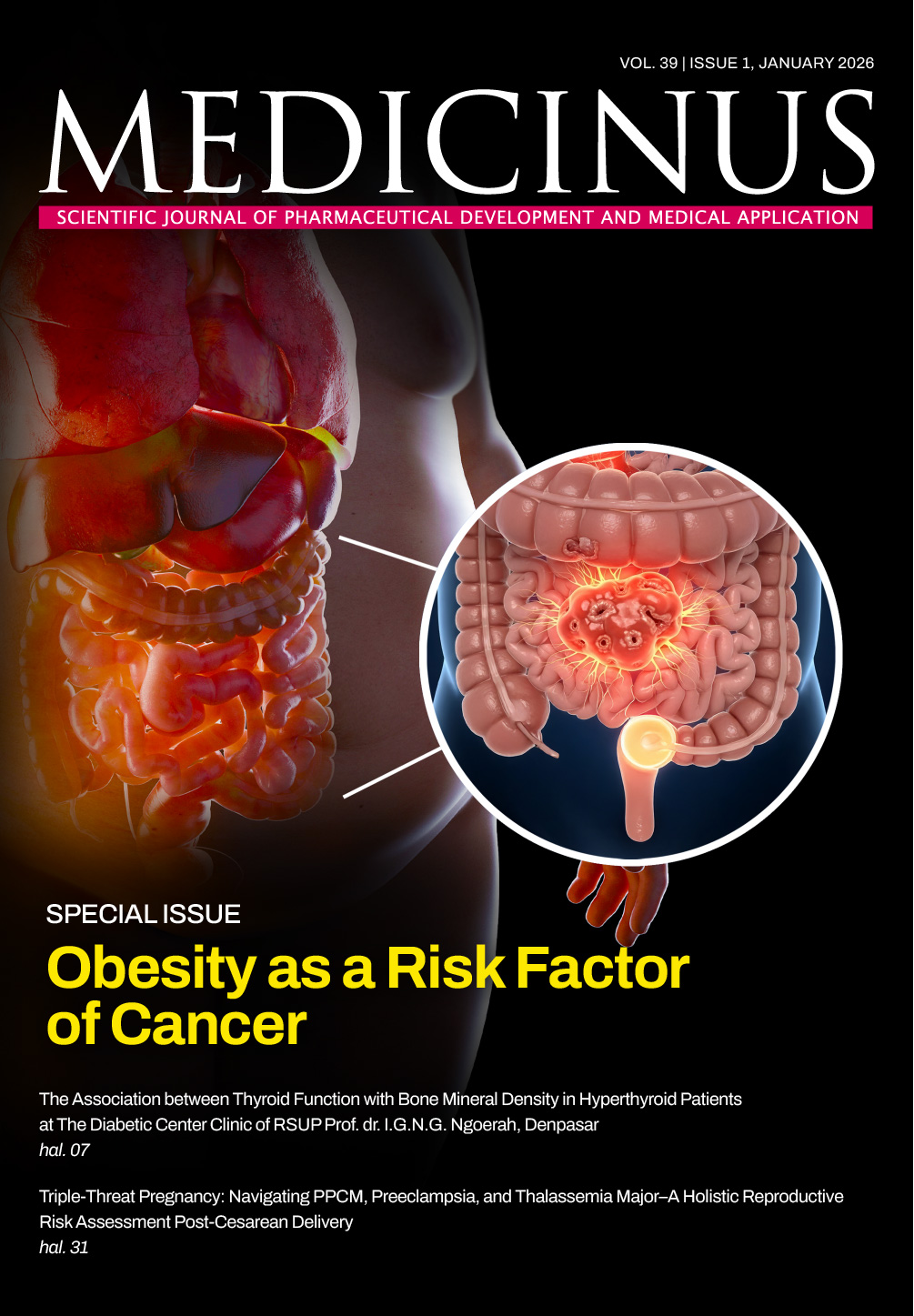
The Association between Thyroid Function with Bone Mineral Density in Hyperthyroid Patients at The Diabetic Center Clinic of RSUP Prof. dr. I.G.N.G. Ngoerah, Denpasar
DOI:
https://doi.org/10.56951/6h1hgs76Kata Kunci:
hipertiroidisme, TSH, FT4, densitas mineral tulangAbstrak
Hipertiroidisme adalah suatu kondisi patologis yang disebabkan oleh kelebihan hormon tiroid yang disintesis dan disekresikan oleh kelenjar tiroid, yang memengaruhi baik fase resorpsi maupun formasi dalam proses remodeling tulang dengan menstimulasi aktivitas osteoblas dan osteoklas, memperpendek waktu remodeling tulang, dan pada akhirnya menyebabkan kehilangan massa tulang yang ditandai dengan penurunan densitas mineral tulang (bone mineral density/BMD). Penelitian ini bertujuan untuk menilai hubungan antara fungsi tiroid (TSH dan FT4) dengan nilai BMD pada pasien hipertiroid. Penelitian analitik observasional dengan desain potong lintang ini dilakukan pada pasien hipertiroid yang menjalani rawat jalan di Klinik Pusat Diabetes RSUP Prof. dr. I.G.N.G. Ngoerah, Denpasar, periode Januari hingga Mei 2024. Partisipan berusia 18–50 tahun dan dipilih berdasarkan kriteria inklusi dan eksklusi. Penelitian ini mengevaluasi kadar TSH dan FT4 dalam hubungannya dengan BMD menggunakan pemindaian dual-energy X-ray absorptiometry (DEXA) pada regio femur dan lumbal, yang dinyatakan dalam Z-score. Data dianalisis menggunakan SPSS 23.0 melalui analisis univariate dan bivariate. Uji korelasi Spearman digunakan, dengan nilai p<0,05 dianggap bermakna. Median usia pasien hipertiroid dalam penelitian ini adalah 34 tahun (19–50 tahun), dengan 84,4% merupakan perempuan. Rerata kadar TSH adalah 0,22±0,45 mIU/l dan rerata kadar FT4 adalah 3,22±3,16 ng/dl. Analisis korelasi Spearman menunjukkan tidak terdapat korelasi antara kadar TSH dan nilai rerata Z-score BMD (r=0,138; p=0,452), sedangkan kadar FT4 menunjukkan korelasi negatif dengan rerata Z-score BMD (r=-0,426; p=0,015). Temuan ini mengindikasikan bahwa kadar FT4 yang lebih tinggi berhubungan dengan BMD yang lebih rendah pada pasien hipertiroid. Penelitian ini menunjukkan adanya hubungan antara kadar FT4 dan BMD pada pasien hipertiroid, sedangkan kadar TSH tidak menunjukkan hubungan yang bermakna dengan BMD.
Unduhan
Referensi
1. Ross DS, Burch HB, Cooper DS, Greenlee MC, Lauberg P, Maia AL, et al. American Thyroid Association Guidelines for Diagnosis and Management of Hyperthyroidism and Other Causes of Thyrotoxicosis. Thyroid. 2016;26(10):1343–421.
2. American Thyroid Association. Hyperthyroidism. Available in https://www.thyroid.org/hyperthyroidism/cited Dec 10th, 2025.
3. Munoz-Ortiz J, Sierra-Cote MC, Zapata-Bravo E, Valenzuela-Vallejo L, Marin-Noriega MA, Uribe-Reina P, et al. Prevalence of hyperthyroidism, hypothyroidism, and euthyroidism in thyroid eye disease: a systematic review of the literature. 2020;9(1):201.
4. Kementerian Kesehatan RI. Riset Kesehatan Dasar (Riskesdas) 2013. Jakarta: Badan Penelitian dan Pengembangan Kesehatan Kementerian Kesehatan; 2013.
5. Delitala A, Scuteri A, Doria C. Thyroid hormone disease and osteoporosis. J Clin Med. 2020;9(4):1034.
6. Hammond I, Lyons DJ. Bone mineral densitometry reporting and the CAR technical standards: tips for the radiologist. Can Assoc Radiol J. 2020;71(2):134–5.
7. Infodatin. Situasi osteoporosis di Indonesia. Pusat Data dan Informasi Kementerian Kesehatan RI. 2020;1–10.
8. Ross DS. Bone disease with hyperthyroidism and thyroid hormone therapy. Thyroid. 1994;4(3):319–26.
9. Gorka J, Taylor-Gjevre RM, Arnason T. Metabolic and clinical consequences of hyperthyroidism on bone density. Int J Endocrinol. 2013;2013: 638727.
10. Deng T, Zhang W, Zhang Y, Zhang M, Huan Z, Yu C, et al. Thyroid-stimulating hormone decreases the risk of osteoporosis by regulating osteoblast proliferation and differentiation. BMC Endocr Disord. 2021;21(1):49.
11. Ahn HY, Cho SW, Lee MY, Park YJ, Koo BS, Chang H, et al. Prevalence, treatment status, and comorbidities of hyperthyroidism in Korea from 2003 to 2018: a nationwide population study. Endocrinol Metab. 2023;38(4):436–44.
12. Taylor PN, Albrecht D, Scholz A, Gutierrez-Buey G, Lazarus JH, Dayan CM, et al. Global epidemiology of hyperthyroidism and hypothyroidism. Nat Rev Endocrinol. 2018;14(5):301–16.
13. Kahaly GJ, Bartalena L, Hegedus L, Leenhardt L, Poppe K, Pearce SH. 2018 European Thyroid Association guideline for the management of Graves’ hyperthyroidism. Eur Thyroid J. 2018;7(4):167–86.
14. Borgström F, Karlsson L, Ortsater G, Norton N, Halbout P, Cooper C, et al. Fragility fractures in Europe: burden, management and opportunities. Arch Osteoporos. 2020;15(1):59.
15. Hammam N. Gheita TA. Epidemiology and awareness of osteoporosis: a viewpoint from the Middle East and North Africa. Int J Clin Rheumatol. 2018;13(3):134–47.
16. Curtis EM, Dennison EM, Cooper C, Harvey NC. Osteoporosis in 2022: care gaps to screening and personalised medicine. Best Pract Res Clin Rheumatol. 2022;36(3):101754.
17. Ale AO, Ogbera AO, Ebili HO, Adeyemo OL, Afe TO. Prevalence, predictive factors, and characteristics of osteoporosis in hyperthyroid patients. Int J Endocrinol. 2018;2018: 3540256.
18. Siderova M, Hristozov K, Tsukeva A. TSH-receptor antibodies may prevent bone loss in pre- and postmenopausal women with Graves’ disease and Graves’ orbitopathy. Arch Endocrinol Metab. 2018;62(2):221–6.
19. Hiruma M, Watanabe N, Mitsumatsu T, Suzuki N, Fukushita M, Matsumoto M, et al. Clinical features of moyamoya disease with Graves’ disease: a retrospective study of 394,422 patients with thyroid disease. Endocr J. 2023;70(2):141–8.
20. Indonesian Society of Endocrinology. Indonesian clinical practice guideline for hyperthyroidism. J ASEAN Fed Endocr Soc. 2012;27(1):34–9.
21. Vanderpump MPJ. The epidemiology of thyroid disease. Br Med Bull. 2011;99:39–51.
22. Zheng M, Wan Y, Liu G, Gao Y, Pan X, You W, et al. Differences in the prevalence and risk factors of osteoporosis in Chinese urban and rural regions: a cross-sectional study. BMC Musculoskelet Disord. 2023;24:46:1–11.
23. Bass MA, Sharma A, Nahar VK, Chelf S, Zeller B, Pham L, et al. Bone mineral density among men and women aged 35 to 50 years. J Am Osteopath Assoc. 2019;119(6):357–63.
24. Hong AR, Kang H. Evaluation and management of bone health in patients with thyroid disease: a position statement of the Korean Thyroid Association. Endocrinol Metab (Seoul). 2023;38(2):175–89.
25. El Hadidy EHM, Ghonaim M, El Gawad SSA, El Atta MA. Impact of severity, duration, and etiology of hyperthyroidism on bone turnover markers and bone mineral density in men. BMC Endocr Disord. 2011;11:15.
26. van Vliet NA, Noordam R, van Klinken JB, Westendorp RG, Bassett JH, Williams GR, et al. Thyroid stimulating hormone and bone mineral density: evidence from a two-sample Mendelian randomization study and a candidate gene association study. J Bone Miner Res. 2018;33(7):1318–25.
27. van Rijn LE, Pop VJ, Williams GR. Low bone mineral density is related to high physiological levels of free thyroxine in perimenopausal women. Clin Endocrinol (Oxf). 2014;170(3):461–8.
28. Chen S, Huang W, Zhou G, Sun X, Jin J, Li Z. Association between sensitivity to thyroid hormone indices and bone mineral density in US males. Int J Endocrinol. 2022;2022:2205616.
29. Xu N, Wang Y, Xu Y, Li L, Chen J, Mai X, et al. Effect of subclinical hyperthyroidism on osteoporosis: a meta-analysis of cohort studies. Endocrine. 2020;69(1);39–48.
30. Belsing TZ, Tofteng C, Langdahl BL, Charles P, Feldt-Rasmussen U. Can bone loss be reversed by antithyroid drug therapy in premenopausal women with Graves’ disease. Nutr Metab (Lond). 2010;7(72):1–10.
Unduhan
Terbitan
Bagian
Diterbitkan
Unduhan
Lisensi
Hak Cipta (c) 2026 Katrin Wilentina Siahaan, Made Ratna Saraswati

Artikel ini berlisensi Creative Commons Attribution-NonCommercial 4.0 International License.
Cara Mengutip