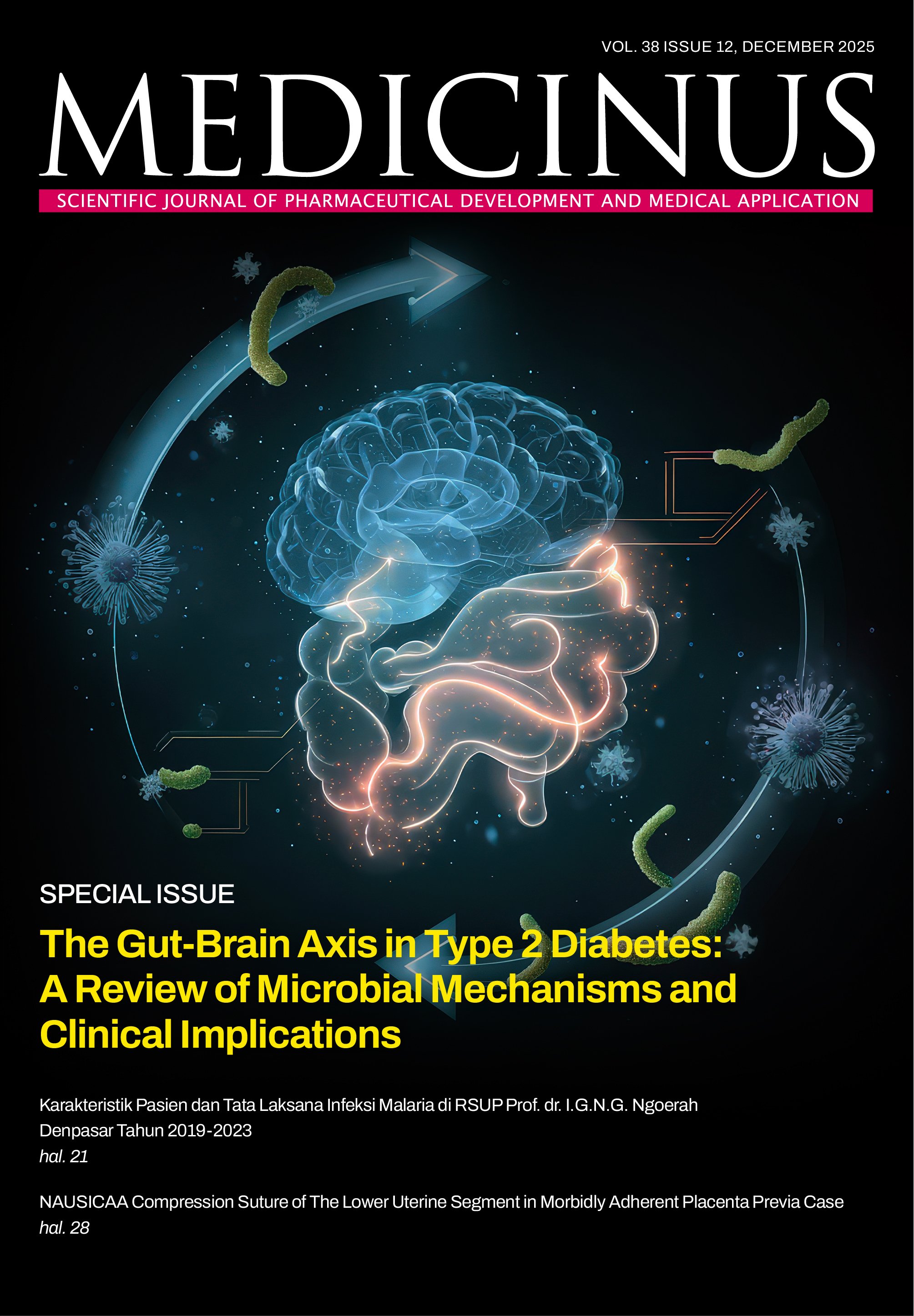
The Gut-Brain Axis in Type 2 Diabetes: A Review of Microbial Mechanisms and Clinical Implications
DOI:
https://doi.org/10.56951/g87wm568Kata Kunci:
diabetes melitus tipe 2, poros usus-otak, mikrobiota usus, resistansi insulin, terapi berbasis mikrobiotaAbstrak
Pemahaman tentang diabetes melitus tipe 2 (DMT2) telah berkembang lebih dari sekadar faktor risiko biasa, yakni dengan
menempatkan mikrobiota usus (gut microbiota/GM) sebagai elemen penting dalam patogenesisnya. Ulasan naratif ini
menguraikan peran penting poros usus-otak (gut-brain axis/GBA), yang menjelaskan bagaimana disbiosis mikroba, yang
ditandai dengan hilangnya bakteri penghasil butyrate, dapat mendorong peradangan sistemik dan resistansi insulin yang
menjadi dasar perkembangan DMT2. Tulisan ini memberikan gambaran umum tentang intervensi berbasis mikrobiota
(probiotik, prebiotik, fecal microbiota transplantation/FMT) dan mengeksplorasi dampak sinergis dari latihan fisik, yang
tidak hanya meningkatkan sensitivitas insulin, tetapi juga secara menguntungkan memodulasi GM. Bukti menunjukkan
bahwa pendekatan terpadu, yang menggabungkan modulasi mikroba yang ditargetkan dengan aktivitas fisik secara
teratur, merupakan strategi terapi yang kuat untuk meningkatkan homeostasis glukosa pada DMT2.
Unduhan
Referensi
1. Pan Y, Bu T, Deng X, Jia J, Yuan G. Gut microbiota and type 2 diabetes mellitus: a focus on the gut-brain axis. Endocrine. 2024;84(1):1–15.
2. Bonaz B, Bazin T, Pellissier S. The vagus nerve at the interface of the microbiota-gut-brain axis. Front Neurosci. 2018;12:49.
3. Dao MC, Everard A, Aron-Wisnewsky J, Sokolovska N, Prifti E, Verger EO, et al. Akkermansia muciniphila and improved metabolic health during a dietary intervention in obesity: relationship with gut microbiome richness and ecology. Gut. 2016;65(3):426–36.
4. Vrieze A, Van Nood E, Holleman F, Salojärvi J, Kootte RS, Bartelsman JFWM, et al. Transfer of intestinal microbiota from lean donors increases insulin sensitivity in individuals with metabolic syndrome. Gastroenterology. 2012;143(4):913-916.e7.
5. Wachsmuth HR, Weninger SN, Duca FA. Role of the gut–brain axis in energy and glucose metabolism. Exp Mol Med. 2022;54(4):377–92.
6. Liu L, Huh JR, Shah K. Microbiota and the gut-brain-axis: implications for new therapeutic design in the CNS. eBioMedicine. 2022;77:103908.
7. Hawley JA, Forster SC, Giles EM. Exercise, the gut microbiome and gastrointestinal diseases: therapeutic impact and molecular mechanisms. Gastroenterology. 2025;169(1):48–62.
8. Wu J, Yang K, Fan H, Wei M, Xiong Q. Targeting the gut microbiota and its metabolites for type 2 diabetes mellitus. Front Endocrinol. 2023;14:1114424.
9. Bajinka O, Tan Y, Darboe A, Ighaede-Edwards IG, Abdelhalim KA. The gut microbiota pathway mechanisms of diabetes. AMB Expr. 2023;13(1):16.
10. Shen Y, Fan N, Ma SX, Cheng X, Yang X, Wang G. Gut microbiota dysbiosis: pathogenesis, diseases, prevention, and therapy. MedComm (2020). 2025;6(5):e70168.
11. Bird SR, Hawley JA. Update on the effects of physical activity on insulin sensitivity in humans. BMJ Open Sport Exerc Med. 2016;2(1):e000143.
12. Sattaru K, Thipani Madhu M, Kumar Singh J, Kandi V, Gupta A, Ca J, et al. A comprehensive review of the effects of diabetes mellitus on the gastrointestinal system. Cureus. 2025;17(1):e77845.
13. Młynarska E, Wasiak J, Gajewska A, Steć G, Jasińska J, Rysz J, et al. Exploring the significance of gut microbiota in diabetes pathogenesis and management—a narrative review. Nutrients. 2024;16(12):1938.
14. Rai S, Sreelatha S, Devang N, Alva PD, Raveendran AV. The microbiota–gut-brain axis and diabetic cognitive impairment: a memorable journey. CD. 2023;12(4):261–71.
15. Drucker DJ. The biology of incretin hormones. Cell Metabolism. 2006;3(3):153–65.
16. Sorski L, Gidron Y. The vagal nerve, inflammation, and diabetes–a holy triangle. Cells. 2023;12(12):1632.
17. Le Chatelier E, Nielsen T, Qin J, Prifti E, Hildebrand F, Falony G, et al. Richness of human gut microbiome correlates with metabolic markers. Nature. 2013 ;500(7464):541–6.
18. Fleming MA, Ehsan L, Moore SR, Levin DE. The enteric nervous system and its emerging role as a therapeutic target. Gastroenterol Res Pract. 2020;2020:8024171.
19. Sankarganesh P, Bhunia A, Ganesh Kumar A, Babu AS, Gopukumar ST, Lokesh E. Short-chain fatty acids (SCFAs) in gut health: implications for drug metabolism and therapeutics. Medicine in Microecology. 2025;25:100139.
20. He J, Zhang P, Shen L, Niu L, Tan Y, Chen L, et al. Short-chain fatty acids and their association with signalling
pathways in inflammation, glucose and lipid metabolism. Int J Mol Sci. 2020;21(17):6356.
21. Ağagündüz D, Çelik E, Cemali Ö, Yesildemir O, Demirci KŞ, Akkus G, et al. Mechanism of actions of probiotics on type 2 diabetes: development and complications. Biomedicine & Pharmacotherapy. 2025;191:118421.
22. Wang Y, Wen L, Tang H, Qu J, Rao B. Probiotics and prebiotics as dietary supplements for the adjunctive treatment of type 2 diabetes. Pol J Microbiol. 2023;72(1):3–9.
23. Ji J, Jin W, Liu SJ, Jiao Z, Li X. Probiotics, prebiotics, and postbiotics in health and disease. MedComm (2020). 2023;4(6):e420.
24. Hernández-Cacho A, García-Gavilán JF, Atzeni A, Konstanti P, Belzer C, Vioque J, et al. Multi-omics approach identifies gut microbiota variations associated with depression. npj Biofilms Microbiomes. 2025;11(1):68.
25. de Groot PF, Frissen MN, de Clercq NC, Nieuwdorp M. Fecal microbiota transplantation in metabolic syndrome: history, present and future. Gut Microbes. 2017;8(3):253–67.
26. Cha RR, Sonu I. Fecal microbiota transplantation: present and future. Clin Endosc. 2025;58(3):352–9.
27. Qin J, Li Y, Cai Z, Li S, Zhu J, Zhang F, et al. A metagenome-wide association study of gut microbiota in type 2 diabetes. Nature. 2012;490(7418):55–60.
28. Sikalidis AK, Maykish A. The gut microbiome and type 2 diabetes mellitus: discussing a complex relationship. Biomedicines. 2020;8(1):8.
29. Oliveira M, Antunes W, Mota S, Madureira-Carvalho Á, Dinis-Oliveira RJ, Dias Da Silva D. An overview of the recent advances in antimicrobial resistance. Microorganisms. 2024;12(9):1920.
30. Uddin TM, Chakraborty AJ, Khusro A, Zidan BRM, Mitra S, Emran TB, et al. Antibiotic resistance in microbes: history, mechanisms, therapeutic strategies and future prospects. Journal of Infection and Public Health. 2021;14(12):1750–66.
31. Salvia MG, Quatromoni PA. Behavioral approaches to nutrition and eating patterns for managing type 2 diabetes: a review. American Journal of Medicine Open. 2023;9:100034.
32. Colberg SR, Sigal RJ, Yardley JE, Riddell MC, Dunstan DW, Dempsey PC, et al. Physical activity/exercise and diabetes: a position statement of the American Diabetes Association. Diabetes Care. 2016;39(11):2065–79.
33. Kootte RS, Levin E, Salojärvi J, Smits LP, Hartstra AV, Udayappan SD, et al. Improvement of insulin sensitivity after lean donor feces in metabolic syndrome is driven by baseline intestinal microbiota composition. Cell Metabolism. 2017;26(4):611-619.e6.
34. Monda V, Villano I, Messina A, Valenzano A, Esposito T, Moscatelli F, et al. Exercise modifies the gut microbiota with positive health effects. Morishita R, editor. Oxidative Medicine and Cellular Longevity. 2017;2017(1):3831972.
35. Schlüter S, Deiss D, Gehr B, Lange K, Von Sengbusch S, Thomas A, et al. Glucose measurement and control in patients with type 1 or type 2 diabetes. Exp Clin Endocrinol Diabetes. 2022;130(S 01):S19–38.
36. Kojta I, Chacińska M, Błachnio-Zabielska A. Obesity, bioactive lipids, and adipose tissue inflammation in insulin resistance. Nutrients. 2020;12(5):1305.
Unduhan
Terbitan
Bagian
Diterbitkan
Unduhan
Lisensi
Hak Cipta (c) 2025 Emmanuel Adrian Goenadi , Ignatius Aditya Haryo Pramudito, Petra Heinson Handoyo Saputra, Pradipta Putramachristy Bararinda, Loury Priskila

Artikel ini berlisensi Creative Commons Attribution-NonCommercial 4.0 International License.
Cara Mengutip